Learn to Sing Without Lessons: 9 Mistakes to Avoid (UK)
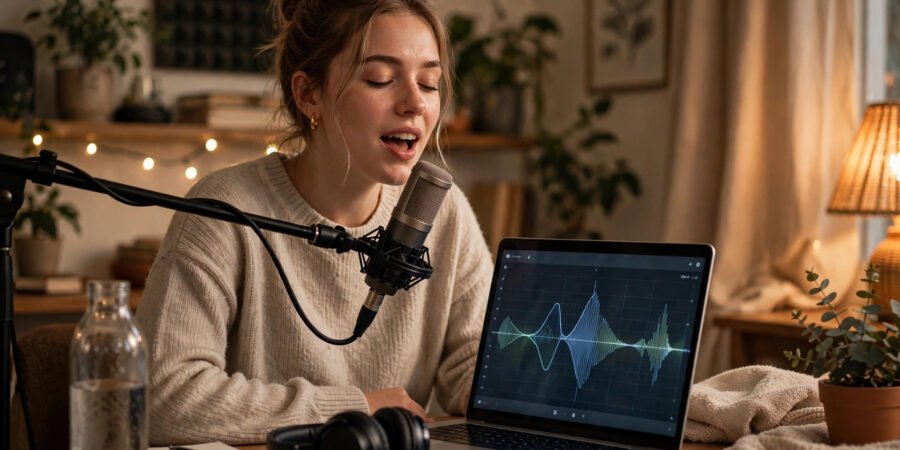
Learning to sing without formal lessons is one of the bravest musical undertakings — no teacher to correct you, no structured path, just your voice, your ears, and the internet. Millions do it successfully. But the absence of a teacher means the absence of early correction, and self-taught singers reliably fall into the same traps: technique errors that limit range, practice habits that entrench bad patterns, and vocal health mistakes that can cause real damage. The mistakes are predictable, which means they are avoidable — if you know what they are.
This guide covers the biggest mistakes self-taught singers make: the technique errors, the practice traps, and the health red lines. Consider it the teacher you do not have, distilled — and if you later want structured support, the Arts Council England funds music and singing opportunities across the country.
Technique Mistakes
1. Singing from the throat instead of the body
The cardinal error. Beginners push sound from the throat — squeezing, straining, reaching up for high notes with neck muscles. Correct singing is a whole-body activity: breath supported by the diaphragm and abdominal muscles, throat open and relaxed, resonance placed forward. The test: if your throat hurts or feels tired after singing, you are throat-singing. The fix: lip trills and humming exercises (which force relaxed airflow), and thinking of sound “coming from” the mask of the face rather than the neck.
2. Shallow breathing
Most beginners breathe like they are sipping air — high, shallow chest breaths that run out mid-phrase. Singing needs diaphragmatic breathing: the belly expands on inhalation (the diaphragm descending), providing a deep reservoir of controlled air. Practise lying down with a book on your stomach — it should rise when you breathe in. Unsexy, transformative.
3. Pushing for range
Straining for notes beyond your current comfortable range — shouting high notes, growling low ones — is how voices get injured. Range expands gradually through relaxed practice at the edges, not through force. The rule: if it hurts, stop. Range is built over months, not conquered in an afternoon.
4. Ignoring pitch accuracy
Without a teacher’s ear, pitch drift goes unnoticed and becomes habitual. Record yourself constantly — the recording hears what your skull hides — and practise with a piano or tuning app for reference. Singing along to tracks is fun but masks your own pitch; a cappella practice with a reference tone builds true accuracy.
5. Neglecting the mixed voice
Beginners typically have a comfortable chest voice and a weak falsetto with an ugly “break” between them. Avoiding the break (by never singing there) preserves it forever. Gentle sirens and slides through the break zone, daily, gradually smooth it into a connected mixed voice — the single most valuable technical development for most singers.
Practice Mistakes
6. Practising songs instead of skills
Running through favourite songs feels like practice but mostly rehearses existing habits — including bad ones. Deliberate practice means isolating weaknesses: the tricky interval, the breathy phrase ending, the wobbly vibrato. Fifteen minutes of targeted exercises outperforms an hour of singing through the playlist.
7. No warm-up
Singing cold is like sprinting cold — injury risk and poor performance. Five to ten minutes of lip trills, humming, and gentle scales before serious singing is non-negotiable. The singers who “never warm up” are either lying or damaging themselves slowly.
8. Inconsistency
An hour on Saturday cannot replace fifteen minutes daily. Vocal technique is motor learning — it consolidates between sessions, like all physical skills. Daily short practice is the entire game; everything else is detail.
Vocal Health Red Lines
9. Singing through pain, hoarseness, or illness
The most dangerous mistake. Pain is the voice’s stop signal — singing through it risks nodules, haemorrhage, and lasting damage. Rest a hoarse voice (real rest: minimal talking, no whispering — whispering strains more than soft speech). Stay hydrated, avoid shouting over noise, and see a GP promptly for hoarseness lasting more than two to three weeks — the BBC Music archives are full of careers interrupted by ignored vocal warnings.
Other health notes: smoking devastates vocal folds; reflux silently inflames them (late-night eating plus singing is a bad combination); and adequate sleep matters more to vocal recovery than any tea or spray. Treat the voice like the athletic instrument it is.
What Self-Taught Singers Should Do Instead
- Record everything. Your most honest teacher is playback.
- Get occasional expert ears. Even two or three lessons a year with a good teacher catches problems self-assessment misses — the highest-value money in self-directed learning.
- Study great singers analytically. Do not just enjoy — dissect: where do they breathe? How do they navigate the break? Imitation with attention is legitimate study.
- Perform early and often. Technique learned in private must survive adrenaline. Our karaoke confidence guide is the gentlest first stage, and our free gigs roundup shows where singers test themselves.
- Rest as seriously as you practise. Voices improve during recovery, not just during work.
The Gear Myth
Beginners obsess over microphones; professionals obsess over rooms and technique. A £3,000 microphone cannot fix throat-singing, and a £100 mic captures a well-supported voice beautifully. Until your technique is solid, gear upgrades are procrastination disguised as progress. Spend the money on a few lessons instead — the highest-ROI purchase in singing, every time. When your voice is ready, then the microphone matters.
The Bottom Line
The biggest mistakes self-taught singers make are: throat-singing instead of supporting from the body, shallow breathing, forcing range, ignoring pitch drift, avoiding the vocal break, practising songs instead of skills, skipping warm-ups, practising inconsistently, and — most dangerously — singing through pain or hoarseness. Fix the breathing and support first, record yourself relentlessly, practise daily in short sessions, warm up always, rest a hurting voice immediately, and buy a few lessons a year for expert correction. The voice is an instrument you cannot replace — train it like one.
Frequently Asked Questions
Can anyone learn to sing, or do you need talent?
Almost anyone can learn to sing well — true tone-deafness (amusia) is rare, affecting ~4% of people. Most “bad singers” have untrained technique, not broken instruments. Pitch, breath control, and tone are trainable skills; the voice responds to practice like any physical ability.
How long does it take to improve as a self-taught singer?
Noticeable improvement in 2–3 months of daily practice; substantial transformation in a year. The voice develops slower than fingers on an instrument — patience is part of the technique, and the voice rewards patience generously.
Are singing apps worth using?
As supplements, yes — pitch-monitoring apps give the objective feedback self-taught singers lack. As replacements for structured practice, no. Use them to check accuracy during exercises, not as the practice itself.
What should I do if my voice hurts after singing?
Stop singing and rest the voice — genuinely rest it, including talking. Total vocal rest, even briefly, beats cautious half-use. If pain or hoarseness persists beyond a few days, or recurs regularly, see your GP. Persistent hoarseness beyond 2–3 weeks always warrants medical attention, not more practice.
Do I really need lessons eventually?
Not necessarily — but even committed autodidacts benefit enormously from occasional expert feedback. Think of it as a technique MOT: a few sessions a year to catch what self-assessment cannot. The best self-taught singers are usually the ones humble enough to get checked.