Overcome Stage Fright Before Performing Solo: A Newcastle Guide
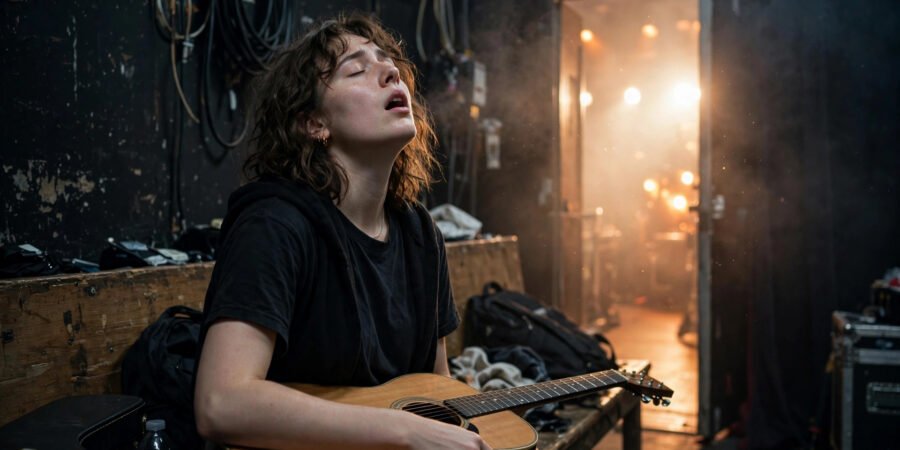
Your hands are shaking. Your throat has closed to the width of a straw. The three songs you knew perfectly in your bedroom have evaporated from your memory, and you are due on stage in ten minutes. Stage fright is the great leveller of performers — it afflicts Grammy winners and first-timers alike, and it feels, in the moment, completely insurmountable. It is not. It is a well-understood physiological response with well-tested counters, and you can absolutely get over it enough to perform — even on your own, even with no coach, even in Newcastle on a wet Tuesday.
This guide gives you science-backed techniques for managing stage fright before a solo performance, Newcastle-specific low-pressure stages to practise on, and an emergency protocol for when nerves hit mid-set.
What Stage Fright Actually Is
Stage fright is your fight-or-flight system misfiring: adrenaline floods your body, heart rate spikes, breathing shallows, muscles tense, and your brain’s threat-detection centre (the amygdala) hijacks the prefrontal cortex — which is why you forget lyrics you knew cold. It is the same response that would serve you brilliantly if a bear appeared; it is just spectacularly unhelpful for singing a ballad.
Two reframes help immediately. First: the audience cannot see most of it. Studies show performers dramatically overestimate how visible their nerves are — your shaking hands feel seismic to you and are barely noticeable from row three. Second: some adrenaline helps. The goal is not zero nerves (which produces flat, lifeless performances) but managed nerves — the physiological sweet spot athletes call “arousal control.” You are not trying to eliminate the energy; you are trying to ride it.
Techniques That Actually Work
Physiological sigh (immediate calm)
Discovered by Stanford researchers: two short inhales through the nose followed by one long exhale through the mouth. This is the fastest known voluntary method of downregulating the stress response — one to three cycles measurably slow your heart rate. Do it in the wings, in the toilet queue, wherever. It works in under a minute.
Cognitive reappraisal (reframe the fear)
Harvard research found that saying “I am excited” out loud outperforms trying to calm down. Why? Your body is already aroused — trying to force calm fights physiology, while relabelling the arousal as excitement works with it. The sensations are identical; only the story changes. Tell yourself the nerves mean you care, not that you are in danger.
Exposure ladder (the long game)
Stage fright fades with graded exposure, not willpower. Build a ladder: play for one trusted friend → record yourself and post it → open mic (short slot) → longer set → headline slot. Each rung survived rewires the threat response. Newcastle’s grassroots scene is ideal for this — more below.
Over-preparation (the boring secret)
Nerves erase roughly 30% of your ability. The professionals’ answer is not confidence — it is preparation so deep the material survives the adrenaline. Know your first 30 seconds cold (the hardest part); have the setlist taped where you can see it; rehearse the transitions between songs, not just the songs. Preparation is the only reliable confidence.
Physical reset
Shake out your hands, roll your shoulders, do star jumps in the green room — burning off adrenaline physically prevents it manifesting as shaking. Warm up your voice properly (lip trills, gentle scales); a warmed-up voice is far less likely to seize than a cold one.
Newcastle: Low-Pressure Stages to Practise On
Newcastle’s music scene is famously supportive — the city’s grassroots venues and open mics are where Geordie performers cut their teeth. Work the ladder locally:
- Open mic nights. Pubs and cafés across Jesmond, Heaton, Ouseburn, and the city centre run weekly open mics — short slots, kind audiences, zero stakes. Arrive early, take a two-song slot, build from there.
- Busking spots. Grainger Street and Northumberland Street are classic pitches. Busking is exposure therapy with tips: the audience is transient, the stakes are nil, and you learn to perform through distraction.
- Community and charity events. Lower pressure than ticketed gigs, appreciative audiences, and a good cause as emotional armour.
- House concerts. Performing for ten friends in a living room splits the difference between bedroom and stage beautifully.
If karaoke feels like a safer first step, our guide to karaoke for shy performers covers the same nerves in a lower-stakes setting — and our roundup of free gigs will get you watching confident performers to study.
The Emergency Protocol: Nerves Hit Mid-Set
It happens to everyone. When it happens to you:
- Slow down, do not speed up. Adrenaline rushes tempo. Consciously drag the pace back — the audience hears confidence in steadiness.
- Breathe between phrases. One physiological sigh at the mic (disguised as a pause) resets more than you would believe.
- Find one friendly face. Sing to one person, not the room. The room follows.
- Have a bailout song. One dead-simple song you could play in your sleep, ready to deploy if a hard one collapses. Professionals all have one.
- Keep going. Audiences forgive mistakes instantly and admire recovery far more than perfection. The only true failure is stopping.
The BBC Music platform documents countless artists’ first-nerve stories — universal, survivable, and usually funny in retrospect — and the Arts Council supports the grassroots venues where those stories begin.
The Bottom Line
Getting over stage fright before performing solo comes down to: understanding it as misfiring physiology (not personal failure), using the physiological sigh and “I am excited” reframe for immediate relief, climbing an exposure ladder from friends to open mics to real gigs, over-preparing the material so it survives adrenaline, and having a mid-set emergency protocol. Newcastle’s supportive grassroots scene is the perfect training ground. The nerves never fully vanish — they just become fuel. Every performer you admire was once exactly where you are now, ten minutes from stage time, hands shaking.
Frequently Asked Questions
Should I use alcohol or beta-blockers for stage fright?
Alcohol is a trap: it dulls nerves slightly while degrading timing, pitch, and judgement significantly — the audience notices the latter more than you feel the former. Beta-blockers (prescribed for performance anxiety) are a legitimate medical option some professionals use; discuss with your GP rather than self-medicating. Techniques first, substances last.
How long does it take to get over stage fright?
Noticeable improvement within 5–10 performances using graded exposure; most regular performers reach comfortable management within a year of consistent gigging. It rarely vanishes entirely — experienced performers describe it shrinking from terror to useful energy.
What if I forget my lyrics on stage?
Have them accessible (music stand, tablet, setlist with first lines) — professionals do this routinely and nobody minds. If you blank anyway: keep the music going, hum or vamp until it returns, and smile. Audiences interpret confidence as competence.
Is stage fright worse for solo performers?
Usually yes — there is nowhere to hide and no bandmate to cover mistakes, which intensifies the exposure. But solos also build resilience fastest: every survived solo set is a bigger confidence deposit than a band gig. The ladder works; it just starts steeper.
Can stage fright ever be a good thing?
Genuinely yes, in moderation. The adrenaline sharpens focus, energises delivery, and signals that the performance matters to you — flat, nerveless performances are forgettable. The aim is harnessing the energy, not eliminating it.