Keeping Indoor Cats Entertained All Day: A UK Owner’s Guide
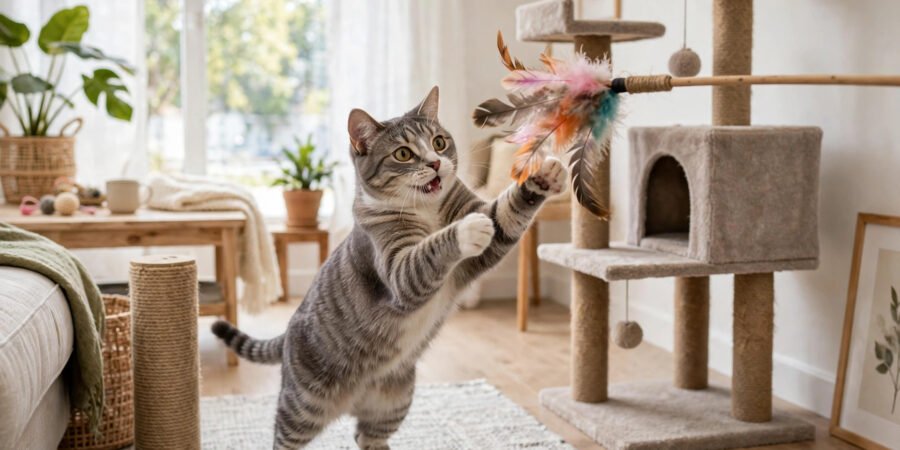
An indoor cat sleeps 12–16 hours a day — so why does the remaining time feel like managing a tiny, destructive tornado? Because cats are crepuscular hunters wired for bursts of intense activity, problem-solving and territorial patrol, and the average UK home offers a sofa, a windowsill and eight empty hours. Boredom in cats is not cute restlessness; it drives scratching, aggression, overeating and stress illnesses.
This guide explains why entertaining indoor cats is hard, the enrichment science that fixes it, a daily routine that works around a job, and the cheap setups that transform a flat into a cat territory.
Why It's Hard: Hunter in a Living Room
The difficulty is structural. A cat's behavioural needs — hunt, catch, kill, eat, groom, sleep, repeated through dawn and dusk — evolved for territories spanning acres. Indoors, the 'hunt' is a food bowl filled while they watch, the 'territory' is rooms they have mapped in a day, and the stimulation gap is enormous. UK specifics compound it: smaller homes, long work hours, dark winters limiting window entertainment, and rental restrictions on modifications.
Boredom manifests as behaviour problems owners misread: 3am zoomies (normal crepuscular energy with nowhere to go), aggression (play aggression from under-stimulation), furniture scratching (territorial marking plus claw maintenance — a need, not spite), and over-grooming or cystitis (stress-mediated illness, genuinely common in under-enriched indoor cats). The fix is never punishment; it is meeting the needs the behaviour signals.
The Enrichment Framework: Five Pillars
Feline behaviourists structure enrichment in five pillars. One: hunting and play — wand toys mimicking prey (not hands — hands teach biting), 2–3 sessions of 10–15 minutes daily, ending with a 'kill' and a meal to complete the hunt cycle. Two: feeding enrichment — puzzle feeders, scattered kibble, lick mats; a cat that works for food is a cat using its brain. Three: vertical space — cats experience territory in three dimensions; shelves, tall scratchers and cleared wardrobe tops multiply a small flat's territory.
Four: sensory — window perches with bird feeders outside (the RSPB-approved kind), cat grass to chew, silvervine or catnip, cardboard boxes (the cheapest enrichment ever made — rotate them). Five: social — indoor cats need interaction; talking, grooming and training (yes, cats train — clicker training works) count. Cats Protection's indoor cat advice details each pillar with product-free DIY options.
The Working Owner's Daily Routine
The routine that works around a 9–5: morning (10 min) — vigorous wand play before work, then breakfast from a puzzle feeder; the hunt-eat-groom-sleep cycle means the cat naps contentedly for hours. Midday — automated toys or a timed feeder scattering lunch; a window bird feeder provides afternoon television. Evening (15 min) — the big play session at dusk, their natural peak, followed by dinner. Night — a final small play or grooming session before your bedtime.
Total active time: 25–30 minutes daily, plus passive enrichment running all day. The common failure is one long weekend session instead of daily short ones — cats need daily rhythm, not weekend marathons. Toy rotation is the free multiplier: keep two-thirds of toys boxed, rotate weekly, and old toys become new again. Managing your household budget note: enrichment need not cost — boxes, paper bags, toilet-roll puzzle feeders and DIY wand toys are free.
Cheap Setups That Transform a Flat
The £50 flat transformation: a tall scratcher with platforms (£30–£40 — the single best purchase, combining scratching, climbing and perching), a window hammock perch (£15), and cardboard everything. DIY vertical space: cleared bookshelf tops, a plank between two sturdy shelves, the top of the wardrobe with a stepped route up. Cats prefer high, warm, enclosed — a box on top of a wardrobe is prime real estate.
For renters: freestanding cat trees need no drilling; over-door hangers and tension-rod shelves avoid wall damage (see making a rental garden look nice without permanent changes for the damage-free mindset applied outdoors). A catio or window box — even a small secured balcony enclosure — gives safe outdoor access that revolutionises indoor cats' lives; check lease terms first. And consider a second cat: the best enrichment for a social young cat is often another cat — adopted as a bonded pair, they entertain each other for hours.
When Boredom Becomes a Vet Issue
Persistent over-grooming to bald patches, sudden aggression, house-soiling in a previously clean cat, or withdrawal can signal stress-related illness (feline lower urinary tract disease, over-grooming dermatitis) rather than mere boredom — vet-check behavioural changes rather than assuming enrichment will fix them. Indoor cats also need the health basics: annual vaccinations, parasite prevention, and weight management (indoor cats trend overweight — puzzle feeding helps).
Blue Cross pet advice stresses that indoor living, done right, gives cats longer, safer lives than roaming — UK indoor cats avoid traffic, the leading killer of cats. The bargain is clear: you provide the enrichment, the cat provides the extra years. Thirty minutes a day and some cardboard is a small price for a content, healthy hunter.
Keeping indoor cats entertained is hard because you are recreating a hunter's world in a living room — but the formula is proven: daily interactive play around dawn and dusk, feeding enrichment, vertical territory, sensory variety, and social interaction, in 25–30 active minutes a day plus clever passive setups.
The bored cat is not a bad cat; it is an under-employed hunter. Employ the hunter — with wand toys, puzzle feeders, high places and boxes — and the 3am zoomies, the shredded sofa and the 5am face-pats resolve into what they were always meant to be: a content cat in a territory that finally feels like theirs.
Managing the Night-Time Zoomies
The 3am wall-sprinting session is the indoor cat's most notorious behaviour — and it is entirely natural: cats are crepuscular, wired for intense activity at dawn and dusk, and a day of napping stores energy that erupts on schedule. You cannot train out biology, but you can reschedule it. The method: a vigorous 15-minute play session in the evening (the 'hunt'), followed by their main meal (the 'eat'), then grooming and quiet time — the full hunt-eat-groom-sleep cycle, timed so the sleep phase lands when yours does.
What not to do: punish the zoomies (the cat is not misbehaving — it is being a cat at cat o'clock), lock the cat out of the bedroom while it yowls at the door (stress for everyone), or respond with 3am play (which trains the schedule you are trying to break). Consistency over 2–3 weeks shifts the pattern for most cats. And accept the residue: the occasional dawn sprint is the price of a predator in the house. Blackout curtains, a closed bedroom door introduced gradually with the cat's own cosy sleeping spot outside it, and earplugs for the transition weeks — management, not war.
Frequently Asked Questions
Why is my indoor cat bored despite having toys?
Static toys lose novelty fast, and cats need interactive hunting play, vertical territory and feeding enrichment — not just objects. Rotate toys weekly, play 2–3 short daily sessions, and add vertical space and puzzle feeders.
How much play does an indoor cat need daily?
Two to three sessions of 10–15 minutes, timed around dawn and dusk peaks, plus passive enrichment (window perches, puzzle feeders, rotated toys) running all day. About 25–30 active minutes total.
Do indoor cats need another cat for company?
Not always, but a second cat is excellent enrichment for young, social cats — bonded pairs entertain each other for hours. Introduce properly and consider your space and budget first.
Is it cruel to keep a cat indoors in the UK?
No — done right, indoor cats live longer, safer lives avoiding traffic and disease. The welfare requirement is enrichment: hunting play, vertical space, feeding puzzles and interaction, which this guide covers.

