Drought-Tolerant Plants for Hot UK Summers: How to Choose
British summers are changing. The heatwaves of recent years — 40°C recorded in the UK for the first time in 2022 — have turned “drought-tolerant planting” from a Mediterranean holiday curiosity into a practical necessity for gardeners from Kent to Yorkshire. Hosepipe bans, parched lawns, and shrivelled borders are the new normal, and the gardeners thriving through it are the ones who planted for the climate we have, not the one we remember.
This guide explains how to choose drought-tolerant plants for hot UK summers: what “drought-tolerant” really means, the toughest plants for heatwaves, how to prepare soil and water intelligently, and the design tricks that make dry gardens beautiful rather than bleak.
What “Drought-Tolerant” Really Means
Drought-tolerant does not mean “never needs water.” It means the plant survives extended dry periods once established — typically needing a first season of regular watering to build deep roots, then coping independently. The distinction matters: even the toughest lavender needs watering in its first summer. Buy drought-tolerant plants for their mature resilience, and commit to their first-year establishment.
Plants achieve drought tolerance through adaptations you can spot: silvery or grey foliage (reflects heat), narrow or small leaves (less water loss), hairy leaves (traps moist air), thick fleshy leaves (water storage — succulents), and deep taproots (reaching subsoil moisture). Learning to read these signs lets you judge any plant’s prospects, not just memorise lists.
The Toughest Plants for Hot UK Summers
Mediterranean classics (proven in the UK)
- Lavender — the drought-tolerant icon. English lavender (Lavandula angustifolia) is hardier than French types; needs sharp drainage, hates winter wet more than summer dry.
- Rosemary — culinary and ornamental, thrives on neglect once established. Upright varieties make excellent hedging.
- Cistus (rock rose) — spectacular papery flowers, resents transplanting (plant young, leave alone), adores poor dry soil.
- Phlomis — architectural woolly foliage, long flowering season, shrugs at drought.
- Eryngium (sea holly) — metallic blue thistles, deep-rooted, dramatic and indestructible.
Ornamental grasses
Grasses are the backbone of dry gardens: Stipa tenuissima (silky movement), Miscanthus varieties (structure and winter interest), Pennisetum (fountain-like seed heads). Deep fibrous roots make them exceptionally drought-resilient, and they ask almost nothing once established.
Perennials that laugh at heatwaves
- Echinacea — prairie native, deep taproot, flowers for months, seeds feed goldfinches in winter.
- Rudbeckia — cheerful, long-flowering, tough as old boots.
- Sedum (stonecrop) — succulent leaves store water; ‘Autumn Joy’ types flower into October.
- Verbena bonariensis — airy purple haze on wiry stems, self-seeds politely, beloved by butterflies.
- Agapanthus — actually flowers better when slightly stressed and pot-bound; a heatwave plant par excellence.
What to avoid
Hydrangeas (notorious water-guzzlers), astilbes, ligularias, and moisture-loving primulas will suffer in dry summers without constant irrigation. Do not fight the site — plant for it. The RHS plant finder lets you filter by drought tolerance, and Gardeners’ World trials new varieties for UK conditions.
Soil Preparation: The Unsexy Secret
Drought-tolerant plants mostly need one thing from soil: drainage. Mediterranean plants rot in winter wet far more often than they die of summer drought — the UK kills more lavenders with soggy winters than dry summers. On clay soils, plant on slight mounds or slopes, add grit to the planting hole (not just compost, which holds water), and consider raised beds for the most drainage-demanding species.
Mulch is the drought gardener’s superpower. A 5–7cm layer of gravel, bark, or composted mulch suppresses weeds (which steal water), insulates soil, and dramatically reduces evaporation. Gravel mulch suits Mediterranean planting aesthetically and practically — it reflects heat, keeps crowns dry, and never needs replacing. Our low-maintenance plants guide overlaps heavily here — drought-tolerant and low-maintenance are close cousins.
Watering Strategy: Less, But Smarter
- Water deeply and rarely. A thorough weekly soak trains deep roots; daily sprinkles train shallow ones and waste water. New plantings excepted — they need regular water for the first season.
- Water the soil, not the plant. Morning watering at the base reduces evaporation and fungal disease. Avoid overhead sprinklers in heatwaves — most water evaporates before reaching roots.
- Use water butts. A 200-litre butt on every downpipe banks winter rain for summer use — free, unmetered, and better for plants than tap water.
- Know the hosepipe ban rules. Bans vary by water company; check yours before the heatwave, not during. Drip irrigation and watering cans usually remain permitted when sprinklers are banned.
- Accept the summer look. Mediterranean gardens go golden and crisp in August — that is the aesthetic, not failure. Lawns brown and recover; it is what they do.
Designing a Beautiful Dry Garden
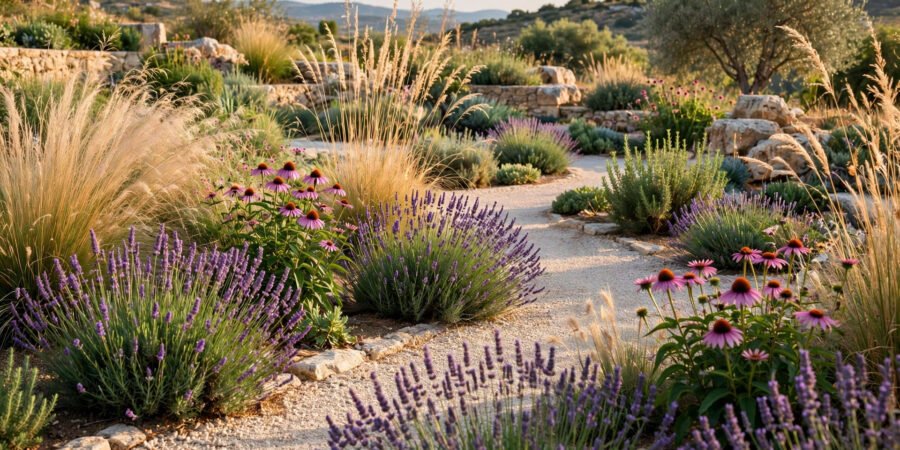
Drought-tolerant does not mean desert-bleak. The Beth Chatto gravel garden in Essex — created on parched, stony ground — is among Britain’s most celebrated gardens, proving dry can be ravishing. Principles: mass plants in drifts (not polka-dots), combine silvers with purples and hot oranges, use grasses for movement, include evergreen structure for winter, and embrace gravel as a design material rather than apologising for it. A dry garden done well looks intentional and modern — increasingly the smartest aesthetic in a warming climate.
And dry gardens are wildlife gardens: the flowers above are pollinator magnets, and reduced irrigation leaves more for nature. Our wildlife-friendly gardening guide shows how drought-tolerant planting and biodiversity go hand in hand.
The Bottom Line
Choosing drought-tolerant plants for hot UK summers means: understanding that “tolerant” means resilient once established (water well in year one); recognising the adaptations (silvery, narrow, hairy, fleshy leaves, deep roots); planting Mediterranean classics, ornamental grasses, and prairie perennials; prioritising drainage and mulch over irrigation; watering deeply but rarely; and designing with the dry aesthetic rather than against it. The climate is not going back — but the gardens that thrive in it are among the most beautiful you can grow.
Frequently Asked Questions
Will drought-tolerant plants survive a UK winter?
Most listed here are fully hardy — the danger is winter wet, not cold. Sharp drainage (grit, mounds, raised beds) matters more than frost protection. Mediterranean plants rot in soggy clay; in free-draining soil they sail through. A sheltered, sunny wall extends what you can grow significantly.
How much should I water new drought-tolerant plants?
Thoroughly for the first growing season — deep weekly soakings that encourage roots downward. Reduce gradually in year two. “Drought-tolerant” describes the established plant; every plant needs water to establish.
Can I grow drought-tolerant plants in containers?
Yes, with caveats: pots dry faster than ground, so use large pots (more soil buffer), terracotta alternatives that retain moisture better, and water-retentive compost mixed with grit. Agapanthus, lavender, and sedums all thrive in pots.
What is the best mulch for dry gardens?
Gravel or stone chippings for Mediterranean-style planting (reflects heat, never rots, suits the aesthetic); bark or composted mulch for mixed borders (improves soil as it breaks down). Either way, 5–7cm deep, kept clear of plant stems.
Should I just replace my lawn with gravel?
Consider reducing, not necessarily eliminating. A smaller lawn with drought-tolerant borders is the pragmatic compromise — less mowing, less watering, more interest. Full gravel gardens suit sunny front gardens brilliantly; keep some lawn if children or dogs need it. Clover lawns are another option — tougher in dry spells and better for pollinators than pure grass.