Why Does Time Slow Near Black Holes? Einstein Explained Simply
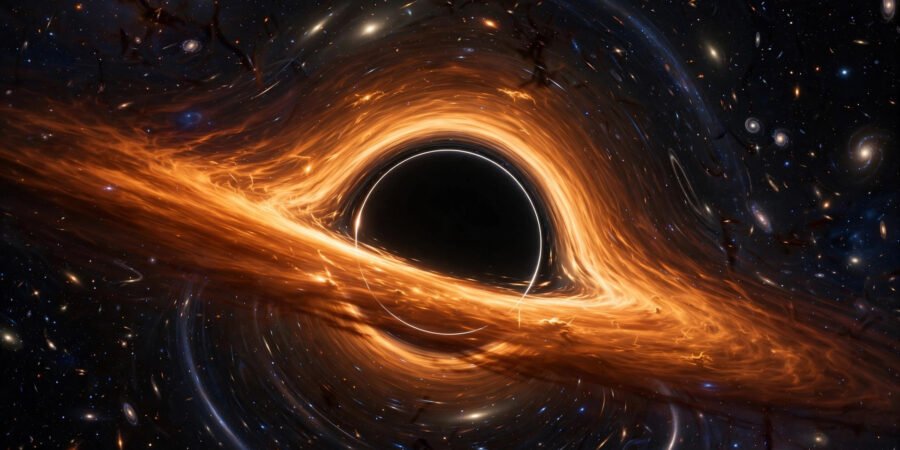
Of all the strange claims in modern physics, “time slows down near a black hole” might be the strangest — and it is also one of the best confirmed. This is not science fiction, not a metaphor, and not a trick of perception. Time itself genuinely runs slower in strong gravity, an effect called gravitational time dilation, and it has been measured with atomic clocks, observed in GPS satellites, and confirmed around black holes by telescopes. You can understand why it happens without any maths. You just need to let go of one everyday assumption: that time ticks at the same rate everywhere.
Einstein’s Big Idea: Spacetime
Before Einstein, time was treated as a universal background clock — the same everywhere, ticking steadily. Einstein’s general relativity (1915) replaced that picture with spacetime: a four-dimensional fabric combining the three dimensions of space with time as the fourth. Massive objects — stars, planets, black holes — curve this fabric, and that curvature is gravity.
The classic analogy: imagine a stretched rubber sheet with a bowling ball in the middle. The ball dents the sheet; a marble rolled nearby curves around the dent. Now extend the analogy: the dent affects not just the marble’s path through space, but the rate at which time flows in the dent. Deeper dent, slower time. A black hole is the deepest dent physically possible — a place where mass has curved spacetime so extremely that the dent becomes a bottomless pit.
Why Stronger Gravity Means Slower Time
Here is the mechanism in plain English. In relativity, everything moves through spacetime at a fixed total “speed” — the speed of light. You can think of it as a budget: the faster you move through space, the slower you move through time, and vice versa. (This is also why time slows for objects moving near light speed — the same budget, spent differently.)
Near a massive object, spacetime is curved, and following the straightest possible path through curved spacetime means your “time budget” gets stretched. Clocks deeper in a gravitational field tick slower relative to clocks further out. This is not clocks malfunctioning — time itself flows at different rates in different places. An astronaut hovering near a black hole would feel time passing perfectly normally (their heart beats once per second, their watch ticks once per second) — but someone watching from far away would see every one of those seconds stretched out, the astronaut moving in agonising slow motion.
How Extreme Does It Get at a Black Hole?
A black hole’s boundary is the event horizon — the point of no return, where escape would require exceeding light speed. As you approach it, time dilation grows without limit. From the outside universe’s perspective:
- An infalling astronaut’s clock appears to tick slower and slower, their light reddening and dimming.
- At the horizon itself, time appears to stop entirely — the astronaut seems frozen at the edge, fading from view. (In reality they fall straight through, experiencing nothing special at the crossing — the weirdness is all in how distant observers see it.)
- Meanwhile, from the astronaut’s perspective, the outside universe appears sped up — they would watch aeons of cosmic history flash past in their final moments.
The film Interstellar dramatised this faithfully: on the water planet orbiting close to the black hole Gargantua, one hour equals seven years back on Earth. The physics consultants calculated it properly — that is a real (if extreme) solution of Einstein’s equations.
But Wait — This Happens on Earth Too
Gravitational time dilation is not confined to black holes; it is happening to you right now. Your head ages very slightly faster than your feet, because it is further from Earth’s centre. The effect is absurdly tiny — you would need atomic clocks to detect it — but it has been measured: in 2010, physicists at the US National Institute of Standards and Technology confirmed time runs faster just 33 centimetres higher up.
More practically, GPS satellites must correct for it constantly. Their clocks run faster than Earth’s surface clocks by about 38 microseconds per day (a combination of weaker gravity speeding them up and their orbital velocity slowing them down). Uncorrected, GPS positions would drift by kilometres within a day. Every time your phone navigates you to a dark-sky spot to see the northern lights, Einstein’s time dilation is quietly making it work.
Time Dilation Is Not Just Gravity
Worth knowing: velocity causes the same effect. Astronauts on the International Space Station age slightly slower than people on Earth due to their orbital speed (partly offset by weaker gravity speeding them up — the net effect is tiny). And if you have ever felt time zones scramble your body clock, that is biology, not physics — though our guide to beating jet lag on US flights covers the earthly version of time going strange.
For deeper dives into cosmic strangeness written for non-physicists, the BBC’s science coverage and Royal Museums Greenwich (home of the Royal Observatory) both publish excellent accessible astronomy explainers.
The Bottom Line
Time slows near black holes because mass curves spacetime, and clocks in deeper gravitational “dents” tick slower relative to those further out — an effect that grows extreme near a black hole’s event horizon, where time appears to stop from the outside. The same effect, in miniature, makes GPS satellites’ clocks run fast and your head age faster than your feet. It feels impossible because everyday life never shows it to us — but it is among the most precisely confirmed predictions in all of physics. Time is not a universal metronome. It is part of the fabric, and the fabric stretches.
Frequently Asked Questions
If time stops at the event horizon, do black holes freeze forever?
From a distant observer’s perspective, infalling matter appears to freeze and fade at the horizon — but this is an optical effect of extreme redshift, not the object literally stopping. In the infalling object’s own frame, it crosses the horizon in finite time and continues inward. Both perspectives are correct in relativity; there is no single universal “now.”
Could time dilation let someone time-travel to the future?
In a limited sense, yes — and astronauts already do it minutely. Spending time in strong gravity or at high velocity means less time passes for you than for everyone else: you “travel” into their future. But it is one-way (no going back), and the effects are tiny except near black holes or at near-light speeds.
Why doesn’t time run backwards inside a black hole?
Inside the event horizon, the mathematics suggests space and time swap roles — all paths lead toward the singularity the way all paths in time lead toward tomorrow. It is not time running backwards; it is the future becoming inescapable. What actually happens at the singularity is unknown — our physics breaks down there.
Has time dilation near black holes been observed?
Yes. Astronomers have measured gravitational redshift and time dilation effects in the orbits of stars around the Milky Way’s central supermassive black hole, Sagittarius A*, and in the light from matter spiralling into black holes across the universe. The Event Horizon Telescope’s images of black hole shadows are consistent with every prediction.
Does this mean time travel to the past is possible?
General relativity’s equations permit some exotic solutions (like wormholes) that could theoretically allow backward time travel, but they require physically implausible conditions such as negative energy. Most physicists consider past-directed time travel impossible in practice, whatever the maths allows on paper.