Quantum Computing Without the Jargon: A Beginner’s Guide (UK)
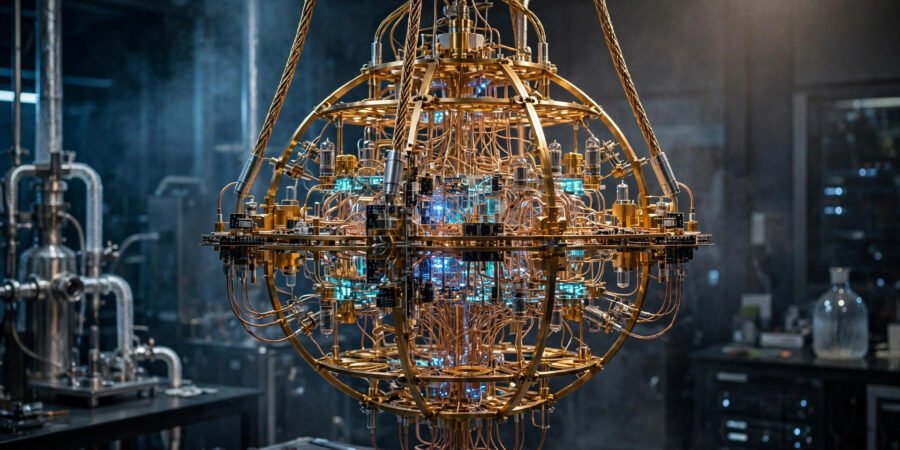
Quantum computing has a marketing problem: every explanation seems to start with “imagine a coin that is heads and tails at the same time” and end with you understanding less than when you began. The hype does not help — breathless claims about “breaking all encryption” and “solving everything” alternate with dismissals that it is all vapourware. Somewhere between those extremes sits a genuinely fascinating technology that the UK is investing hundreds of millions of pounds in.
This guide explains quantum computing without the jargon: what it actually is, how it differs from your laptop, what it might realistically do, and how long it takes to grasp the core ideas. Spoiler: the concepts take an afternoon; the maths takes a physics degree, which you do not need.
Ordinary Computers vs Quantum Computers: The Core Difference
Your laptop, phone, and every computer ever mass-produced works with bits: tiny switches that are either 0 or 1. Everything — photos, banking, this article — is strings of these two values processed billions of times a second. Classical computers are magnificent at this, and they will remain better than quantum computers at nearly all everyday tasks.
A quantum computer works with qubits. A qubit exploits two quantum-mechanical properties:
- Superposition. While a bit is 0 or 1, a qubit can exist in a blend of both simultaneously. Two qubits can represent four combinations at once; three qubits, eight; and so on exponentially. With 300 qubits, you can represent more combinations than there are atoms in the observable universe. (You cannot read them all out — that is the catch — but the computational space is vast.)
- Entanglement. Qubits can be linked so that measuring one instantly determines the state of another, no matter the distance. Einstein called it “spooky action at a distance” and disliked it; a century of experiments confirms it is real.
The everyday analogy that actually helps: a classical computer explores a maze by trying one path at a time, very fast. A quantum computer explores many paths simultaneously, then amplifies the probability of the correct answer emerging when measured. It is not “faster” in general — it is a different kind of machine suited to different kinds of problems.
What Quantum Computers Might Actually Be Good For
Forget “replacing your laptop.” Quantum computers target problems where the number of possibilities explodes beyond classical reach:
- Drug discovery and materials science. Simulating molecules is brutally hard for classical computers because molecular interactions are quantum-mechanical. A quantum computer simulates them natively. Designing better batteries, fertilisers (greener ammonia production could transform agriculture), and drugs are the most-cited near-term prizes.
- Optimisation. Delivery routes, financial portfolios, manufacturing schedules — problems with astronomical combinations where finding the best answer matters enormously.
- Cryptography — both breaking and making. A large enough quantum computer could break current public-key encryption (RSA, elliptic curve) via Shor’s algorithm. This is real but distant — estimates range from a decade to several — and it is why governments are already migrating to “post-quantum” encryption standards.
What they will not do: browse the web faster, run your spreadsheets, or play games. Quantum computers are specialist accelerators for specific problem classes, not general-purpose upgrades. Anyone selling you quantum as “the next laptop” misunderstands it.
Why It Is So Hard to Build
Qubits are exquisitely fragile. The leading designs — superconducting circuits chilled to near absolute zero (colder than deep space), or individual atoms trapped by lasers — lose their quantum state at the slightest disturbance: a vibration, a stray photon, a whisper of heat. This is called decoherence, and it is the field’s central enemy.
The fix is error correction: encoding one reliable “logical qubit” across many physical qubits, so errors can be detected and fixed. But the overhead is brutal — estimates suggest thousands of physical qubits per useful logical qubit. Today’s machines have hundreds to low thousands of physical qubits, mostly too noisy for sustained computation. Progress is real (error rates are falling, qubit counts rising) but the road to fault-tolerant machines doing useful work is measured in years, not months.
This is also why quantum computers live in specialised facilities, not on desks: they need dilution refrigerators the size of wardrobes and teams of physicists to keep them running. Your laptop fan working overtime is a trivial thermal problem by comparison — see our explainer on why laptop fans run loudly for the classical version of heat management.
The UK’s Quantum Bet
Britain is a serious player. The UK National Quantum Technologies Programme, running since 2014 with over £1 billion in public and private investment, funds research hubs, startups, and the National Quantum Computing Centre in Oxfordshire. British universities — Oxford, Cambridge, Imperial, UCL — are world-leading in quantum research, and a cluster of UK startups is commercialising everything from quantum software to quantum-secured communications.
The strategy is pragmatic: even before full-scale quantum computers arrive, “quantum-inspired” algorithms and quantum sensing (ultra-precise measurements for navigation, medical imaging, and infrastructure monitoring) deliver value. The BBC’s technology coverage tracks these developments accessibly, and the Royal Society publishes authoritative explainers on the UK’s quantum programme.
How Long Does It Take to Understand?
The core concepts — bits vs qubits, superposition, entanglement, and what quantum computers are for — take a focused afternoon, and this guide has just given you most of it. Genuine working understanding (the maths of quantum states, algorithm design) requires linear algebra and quantum mechanics — a university-level commitment. But here is the thing: you can understand what the technology is, why it matters, and what the realistic timeline looks like without touching an equation. That conceptual literacy is what most people need, whether you are a curious reader, a student choosing a field, or a professional watching where computing goes next.
For context on how another transformative technology is already woven into daily life, see our guide to AI in everyday UK life — quantum’s story is at an earlier chapter, but the pattern of hype-to-reality rhymes.
The Bottom Line
Quantum computing uses qubits — exploiting superposition and entanglement — to tackle specific problems (molecular simulation, optimisation, cryptography) that overwhelm classical computers, rather than replacing them. Building reliable machines is brutally hard because qubits are fragile, and useful fault-tolerant computers are years away, not months. The UK is investing heavily and leading in research. And understanding the core ideas genuinely takes an afternoon: a quantum computer is not a faster laptop, it is a different kind of machine for a different kind of problem. Everything else is detail — fascinating detail, but detail.
Frequently Asked Questions
Will quantum computers break all encryption?
A sufficiently large fault-tolerant quantum computer could break widely-used public-key encryption via Shor’s algorithm — but such machines do not exist yet, likely not for a decade or more. Governments and industry are already migrating to quantum-resistant “post-quantum” cryptography standards as a precaution.
Can I buy a quantum computer?
Not meaningfully. What exists are research machines in specialised facilities, plus cloud access offered by companies like IBM and Amazon Braket that lets researchers run experiments remotely. There is no consumer quantum computer and none is on the horizon — nor would it be useful for everyday tasks.
What is quantum supremacy?
The milestone (claimed by Google in 2019) of a quantum computer performing a calculation infeasible for any classical computer. It was a real technical achievement on a contrived problem — not a useful computation, but proof the hardware direction works. The field has since focused on “quantum advantage”: doing something useful that classical computers cannot.
Do I need physics to work in quantum computing?
For hardware and algorithm research, yes — typically a physics, maths, or computer science degree. But the growing quantum industry also needs software engineers, business developers, policy experts, and technical writers. Conceptual literacy (what this guide gives you) is the entry ticket to following the field.
Is the UK leading in quantum computing?
The UK is a genuine leader in quantum research and has the world’s most coordinated national programme relative to its size, with world-class universities and a growing startup cluster. The US and China invest more in absolute terms; Britain’s strength is research excellence and early commercialisation.