Free Games Actually Worth Playing Right Now (2026 Guide)
What most people get wrong finding free games worth playing in 2026: the titles worth your time on PC, console and mobile, plus how to spot pay-to-win traps.
Free games have an image problem. Mention them and people picture shovelware — ad-stuffed mobile clones, abandoned early-access husks, and “free” games that cost £50 in microtransactions to enjoy. That reputation was earned a decade ago. In 2026, the free games actually worth playing include some of the best multiplayer experiences on the planet, genuine critical darlings, and single-player adventures that ask nothing of your wallet.
This guide covers what most people get wrong when finding free games worth playing right now in 2026: where the genuinely good free games live, the titles worth your time across PC, console and mobile, and how to spot the traps.
What People Get Wrong About Free Games
Wrong thing one: “free means low quality.” Fortnite, Apex Legends, Warzone, Rocket League, League of Legends, Valorant, Genshin Impact, Destiny 2’s free tier, Path of Exile — these are not charity cases; they are among the most-played games in the world, sustained by cosmetic microtransactions from a fraction of players. The free experience is the real experience. Wrong thing two: “I’ll just browse the free section.” Storefront free charts are polluted by asset flips and ad farms. Curation — from journalists, communities and friends — is how you find the gems. Wrong thing three: “free-to-play always means pay-to-win.” The best free games sell cosmetics and battle passes, not power. Learning to distinguish the models saves both money and disappointment.
The Eurogamer team (UK-based) and Rock Paper Shotgun both maintain regularly updated free-game recommendations from critics who actually play them — far more reliable than store algorithms.
The Free Games Actually Worth Playing in 2026
Battle royale & shooters: Fortnite (still the cultural juggernaut; its creator modes are a platform unto themselves), Apex Legends (the best gunplay in the genre), Call of Duty: Warzone (for the military-shooter crowd), Valorant (tactical, Counter-Strike-descended, PC only). Co-op & social: Rocket League (football with rocket cars — easy to learn, lifetime to master), Fall Guys (chaotic party game, perfect with friends), Among Us (still brilliant with the right group). RPGs & adventure: Genshin Impact (a genuinely gorgeous open-world action RPG — gacha monetisation, but the free journey is vast), Path of Exile (the deep, dark ARPG for Diablo fans), Destiny 2 (expansive free sci-fi shooter content). Strategy & MOBA: League of Legends, Dota 2 (completely free heroes — the fairest model in gaming), Teamfight Tactics.
Hidden gems: the Epic Games Store gives away a free premium game every single week — no catch, yours to keep. Claiming these weekly has built many players libraries of dozens of £30+ games for £0. It is the single best deal in gaming and astonishingly underused. Beyond Epic, watch for Amazon Prime Gaming’s monthly freebies, GOG’s occasional giveaways, and Steam’s free-weekend events that let you trial premium games free for 48 hours. The patient gamer’s library grows fastest: wishlist everything, buy nothing until a deep sale, and claim every freebie religiously.
Where to Find Them (PC, Console, Mobile)
PC: Steam’s free-to-play section (filter by user reviews — “Overwhelmingly Positive” free games are the signal), Epic Games Store (weekly freebies + free-to-play), GOG (occasional freebies, DRM-free). PlayStation/Xbox/Switch: each store has a free-to-play section; PlayStation Plus and Xbox Game Pass Core include monthly games, and Nintendo Switch has a solid free-to-play catalogue (Fortnite, Rocket League, Apex all run well). Mobile: the minefield — stick to known quantities (Pokémon Go, Genshin Impact, Rocket League Sideswipe, Netflix Games’ included-with-subscription titles) and avoid anything whose reviews mention aggressive monetisation. The Guardian’s games section covers the business models honestly.
Spotting the Traps: Pay-to-Win vs Fair Free
Before investing 50 hours, check the monetisation model. Green flags: cosmetics-only shops, battle passes with free tracks, all gameplay content earnable, developers transparent about odds. Red flags: power sold directly (better guns, faster progression for cash), energy/stamina systems gating play behind timers, loot boxes with undisclosed odds (now regulated in some markets), and “free” games demanding payment to remove ads every 30 seconds. Read the Steam or app-store reviews filtered by “most helpful” — players are brutally honest about monetisation.
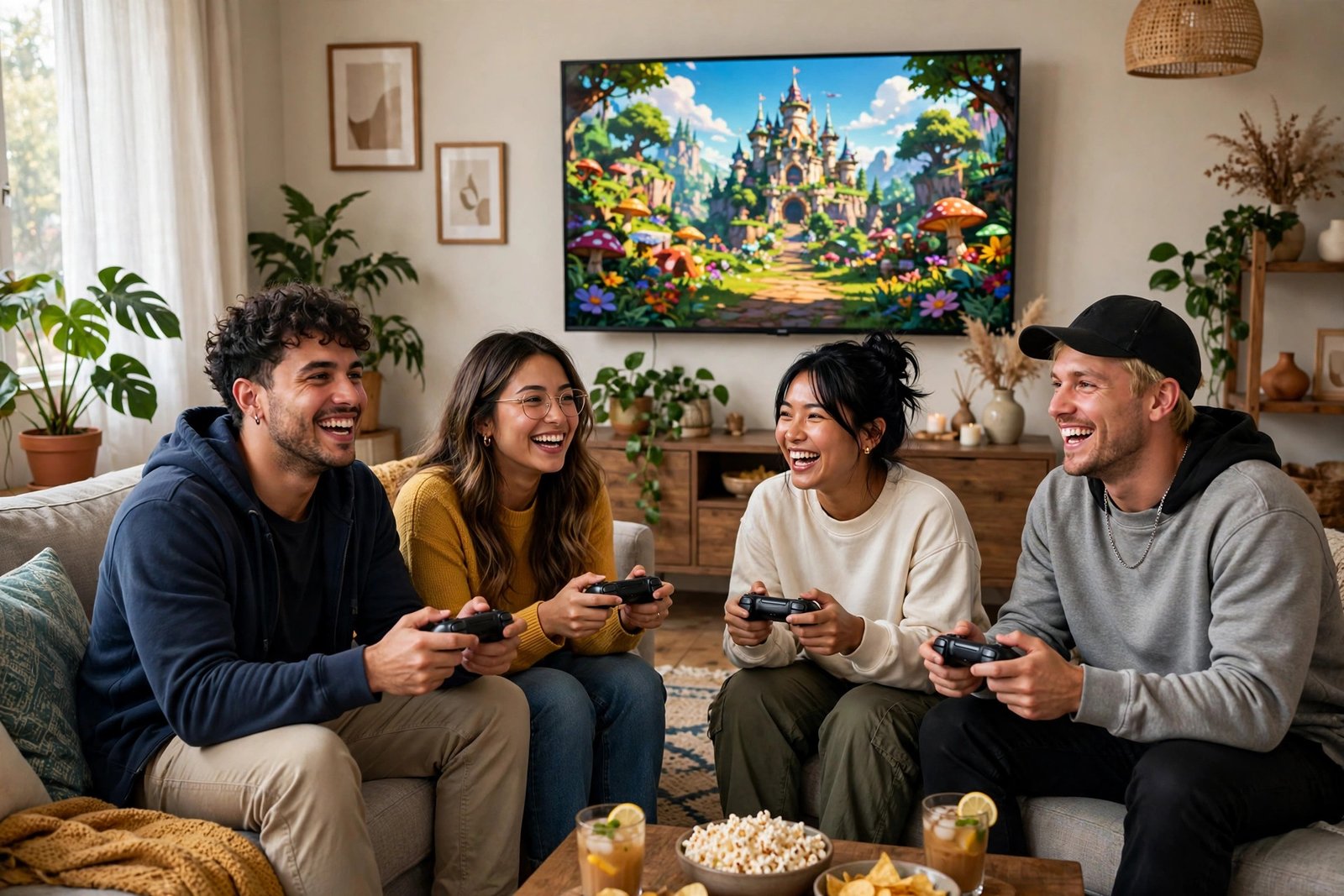
Set spending rules before you start: many players enjoy a strict £0 policy; others allow themselves one battle pass per season as entertainment budget. Either is fine — the trap is unplanned spending. And if gaming is a social thing for you, planning the perfect games night and the best board games for adults extend the fun offline. Thinking of hardware? Check what to check before buying a used games console in the UK before spending on kit.
Free Games for Kids: A Parent’s Safety Guide
Free games and children are a combination that demands parental attention — the games are designed to be compelling, and the monetisation is designed to be frictionless. The risks: in-app purchases (children have racked up thousands on parents’ cards — disable them in device settings before handing over the device), loot boxes (functionally gambling mechanics; several countries now regulate them), chat with strangers (disable or supervise in-game chat), and excessive screen time (the games are engineered for retention).
The safe setup: create child accounts (with spending disabled and age-appropriate content filters) on every platform — PlayStation, Xbox, Nintendo, Apple and Google all offer robust parental controls free. Choose the right games: Rocket League, Fall Guys, Pokémon Go and the Epic weekly freebies skew family-friendly; check age ratings (PEGI in the UK) rather than assuming “free” means “for kids.” Play together first: 30 minutes playing alongside your child teaches you the game’s social features, spending prompts and chat functions better than any guide. Set the money rules explicitly: “this game costs nothing, and we spend nothing in it” — clear, stated, enforced by the disabled purchase settings. Free games can be wonderful for kids — creativity, problem-solving, playing with friends — once the commercial machinery is fenced off.
Conclusion
Finding free games actually worth playing in 2026 is about ignoring the storefront charts and following curation: the battle royales and live-service giants that earned their player counts, the Epic weekly freebies that build a premium library for nothing, and the fair-monetisation models that respect your time. Free no longer means compromised — it means the industry’s biggest games competing for your attention. Start by claiming this week’s Epic freebie today; by Christmas your library could be worth hundreds, and you will not have spent a penny.
Frequently Asked Questions
What are the best free games in 2026?
Fortnite, Apex Legends, Rocket League, Valorant, Genshin Impact, Path of Exile, League of Legends and Dota 2 lead the pack — all genuinely free with fair monetisation.
Are free games on the Epic Games Store really free?
Yes. Epic gives away 1–2 premium games weekly; once claimed, they are yours permanently. No subscription or purchase required.
How do free-to-play games make money?
Mostly cosmetics (skins, emotes) and battle passes bought by a minority of players. The best ones never sell gameplay power.
What is pay-to-win?
When a free game sells competitive advantages — stronger weapons, faster progression — so paying players beat non-paying ones. Avoid these; fair free games sell only cosmetics.
Are free mobile games safe for kids?
Many use aggressive monetisation aimed at impulse spending. Use parental controls, disable in-app purchases, and stick to well-reviewed titles.