SPF Explained: Why Daily Sunscreen Matters in the UK
Britain has a complicated relationship with sunscreen. We are a nation that considers 22°C a heatwave, treats overcast skies as UV immunity, and applies sunscreen — if at all — like a tourist activity reserved for foreign holidays. Meanwhile skin cancer rates have been climbing for decades, and the science of sun protection has moved far beyond “slap on factor 30 in August”. Why is it so hard to understand SPF and why does daily sunscreen matter? Because the numbers are misleading, the application guidance is widely ignored, and the British weather creates a false sense of safety. This guide dismantles the confusion piece by piece — what SPF actually measures, how much to use, when clouds do not protect you, and how to build a daily habit that actually sticks.
What SPF actually measures (and what it does not)
SPF — Sun Protection Factor — measures protection against UVB rays, the ones that burn. SPF 30 filters roughly 97% of UVB; SPF 50 filters about 98%. That tiny-sounding difference matters less than people think — the real-world gap between 30 and 50 is dwarfed by the gap between “applied properly” and “applied like most humans”. Crucially, SPF says nothing about UVA — the rays that age skin, drive most skin cancers and penetrate cloud and glass. In the UK, look for the UVA star rating (a circled UVA logo means UVA protection of at least one-third the SPF) or the EU/UK “broad spectrum” standard. A high SPF with poor UVA protection is like a locked front door with the back door open.
The numbers also deceive through false precision. SPF 100 is not “twice as good” as SPF 50 — it filters about 99% versus 98%. What actually separates good protection from bad is how much you apply and how often you reapply, which is where almost everyone fails. The NHS sunscreen and sun safety guidance sets out the evidence-based basics clearly.
The application gap: why your SPF 50 behaves like SPF 10
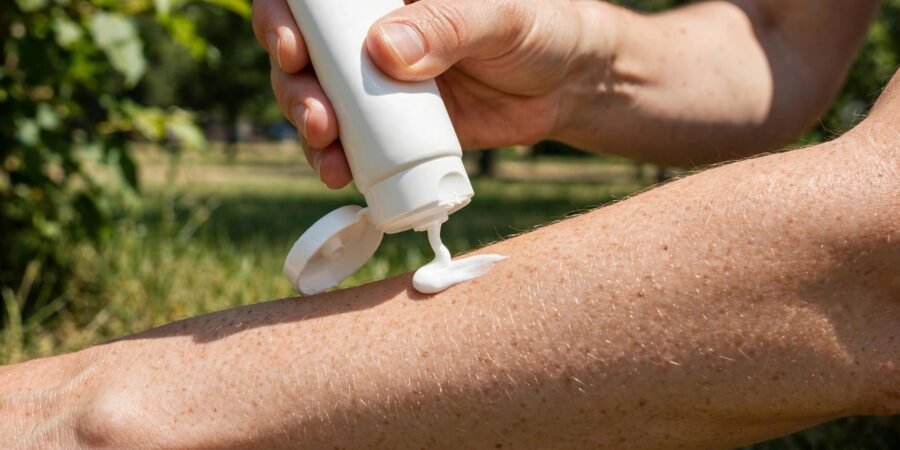
Here is the statistic that should be on every bottle: the average person applies one-quarter to one-half the amount used in SPF testing. Protection does not scale linearly — applying half the tested amount does not give half the SPF; it gives roughly the square root, so SPF 50 applied thinly performs like SPF 7. The tested amount is 2mg per square centimetre: about two finger-lengths of product for the face and neck, a shot glass (35ml) for the full body in swimwear. Almost nobody uses this much, which means almost nobody gets the protection they think they are getting.
Then there is reapplication — or the absence of it. Sunscreen degrades with UV exposure, migrates with sweat and touch, and rubs off on clothing. The guidance is reapply every two hours outdoors and after swimming or heavy sweating, but surveys consistently show most people apply once in the morning and consider the job done. A single morning application, thinned by under-dosing, is often functionally gone by lunchtime. The fix is unglamorous: apply generously, reapply religiously. The British Association of Dermatologists sunscreen factsheet is the UK’s most authoritative short read on getting this right.
The spots everyone misses
Ears, back of the neck, tops of feet, lips, the parting in your hair, and the backs of hands — the most common sites for skin cancers map almost exactly onto the most commonly missed spots. Lip SPF exists for a reason. And drivers should note: UVA penetrates car windows, so the left side of the face (in the UK) accumulates damage over years of commuting.
“But it’s cloudy” — the British delusion
Up to 80% of UV radiation penetrates cloud cover. The UK’s default grey sky is not protection; it is a trick of the light that removes the heat cue (infrared) while leaving the damaging UV largely intact. This is why Britons burn on overcast beach days in Cornwall and why gardeners develop asymmetric sun damage. The UV index — not the temperature, not the cloud — is the number to check: at index 3 and above, protection is advised, and much of the UK exceeds 3 from April to September. The Met Office includes UV forecasts routinely; checking takes ten seconds.
Altitude, reflection and season multiply the effect: UV reflects off water, sand and even grass; spring sunshine after a pale winter catches skin with zero acclimatisation (the Easter burn is a British tradition); and snow — for skiers — reflects up to 80% of UV. Daily sunscreen matters precisely because UV damage is cumulative and mostly invisible until decades later. Our guide to fabrics for sensitive skin covers the complementary strategy — UPF-rated clothing that protects without reapplication faff.
Daily sunscreen: making it automatic
The dermatological consensus has shifted decisively: sunscreen is not a beach product, it is a daily product, because incidental exposure — the commute, the school run, lunch in the park — accumulates into the majority of lifetime UV dose. Photoageing (wrinkles, pigmentation, sagging) is overwhelmingly UV-driven; the famous “sunscreen twins” comparisons show decades of visible difference from daily use alone. And skin cancer — over 16,000 melanoma cases annually in the UK, plus hundreds of thousands of non-melanoma cases — is substantially preventable.
Making it stick requires removing friction: choose a daily SPF you actually enjoy wearing (modern fluid and gel formulas have ended the era of the white cast and the grease slick — though deeper skin tones should still test for cast); keep it next to your toothbrush, not buried in a drawer; use the two-finger measure until it is muscle memory; and layer it as the final skincare step every morning, no decision required. Habit research is clear: anchor it to an existing routine and remove the daily “should I?” — the answer is always yes from March to October, and yes on bright winter days too. Cancer Research UK’s sun safety pages explain the cancer-prevention case with the seriousness it deserves.
Choosing your sunscreen without the headache
Ignore the marketing fog and check four things: SPF 30 minimum (50 for fair skin, children, or strong sun); high UVA protection (circled UVA logo, 4–5 stars); a formula you will actually wear daily (this outweighs every other factor — the best sunscreen is the one you use); and water resistance if swimming or sweating. Mineral vs chemical is largely personal preference in 2026 — modern filters of both types are effective; choose by skin tolerance. For the face, dedicated facial SPFs layer better under makeup. And remember our colour advice — colours for pale skin tones — because the fairest UK complexions, which burn fastest, deserve both protection and a palette that flatters.
Conclusion
SPF is hard to understand because the numbers mislead, under-application silently destroys the stated protection, and British weather disguises the risk. The simple version: SPF measures UVB, you need UVA protection too, apply two finger-lengths to the face and reapply every two hours outdoors, and wear it daily from spring to autumn regardless of cloud. Do that and you have understood more about sun protection than 90% of the population — and your skin, in twenty years, will show it.
Frequently Asked Questions
Why is it so hard to understand SPF and why does daily sunscreen matter?
SPF numbers mislead (SPF 50 is only marginally better than 30), most people apply a quarter of the tested amount (collapsing real protection), and UK cloud cover blocks only ~20% of UV — creating false safety. Daily use matters because cumulative incidental exposure drives most photoageing and much skin cancer.
How much sunscreen should I apply to my face?
Two finger-lengths (index and middle finger, full strips) for face and neck — roughly a quarter teaspoon for the face alone. Most people apply far less, which dramatically reduces the effective SPF.
Do I need sunscreen on cloudy days in the UK?
Yes, from roughly April to September. Up to 80% of UV penetrates cloud, and the UK regularly exceeds UV index 3 in these months. Check the Met Office UV forecast rather than judging by temperature or brightness.
Is the SPF in my moisturiser enough?
Usually not as a standalone — you would need to apply far more moisturiser than normal to reach the tested SPF. Use a dedicated sunscreen as your final morning skincare step and treat SPF in makeup or moisturiser as a bonus.