How Tennis Scoring Works: A Complete Beginner’s Guide
Love, fifteen, thirty, forty — tennis scoring sounds like someone reading random numbers off a bingo card. Every summer, millions of Britons settle in for Wimbledon, nod along confidently, and secretly have no idea why the score jumps from 15 to 30 to 40, or what “deuce” actually means. If that is you, welcome. Tennis scoring is genuinely strange, but it is not complicated. Twenty minutes with this guide and you will follow every rally like a regular.
Here is the best way to understand tennis scoring for beginners: learn the points first, then games, then sets, then the odd little extras like tie-breaks. Each layer builds on the last, and by the end the whole strange system clicks into place.
Points: The Weird Numbers (15, 30, 40)
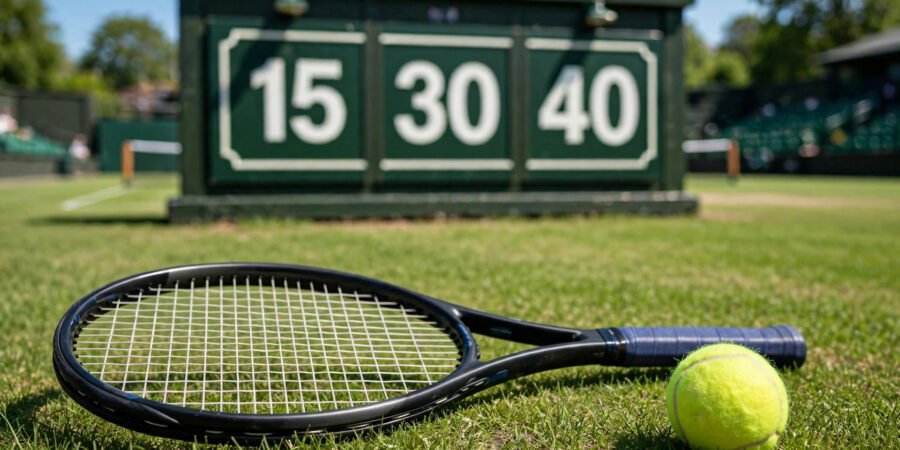
A tennis match is built from points, and points have the strangest names in sport. The server’s score is always announced first. Win your first point and the score is 15–0 (“fifteen–love” — love means zero, from the French l’oeuf, the egg). Win the second and it is 30–0. Win the third and it is 40–0. Win the fourth and you win the game — provided you are two points ahead.
The leading theory for the odd numbers is medieval: they come from clock faces, with points worth 15 minutes each (15, 30, 45), and 45 later shortened to 40 to allow for the two-point margin. Nobody knows for certain — which is somehow fitting for tennis — but the clock theory is the one historians favour. The LTA’s official rules of tennis set out the scoring system as played across Britain.
Memorise this tiny table and you have cracked half of tennis:
0 points = love · 1 point = 15 · 2 points = 30 · 3 points = 40 · 4 points (two ahead) = game. That is genuinely all there is to the numbers.
Deuce and Advantage: The Tug of War
When both players reach 40–40, the score is called deuce. From here, someone must win two consecutive points to take the game. Win the next point and you have advantage (“ad-in” if you are serving, “ad-out” if receiving). Win the point after that and the game is yours. Lose it, and the score falls back to deuce.
This is why tennis games can swing wildly in length. A game can end in four points (40–0, then game) or stretch through deuce six, eight, ten times — a single game lasting fifteen minutes is not unusual in a big match. Deuce is where matches are really decided: the player who handles the pressure of advantage points usually handles the match. When commentators say a player “saved three break points,” they mean the receiver was one point from winning the server’s game three times and the server fought back through deuce each time.
Games and Sets: Building the Scoreboard
Points make games; games make sets. To win a set, you must win at least six games and be two games ahead — so 6–4 or 7–5 wins the set, but 6–5 does not. If the set reaches 6–6, a tie-break decides it (more on that below).
The server alternates every game: Player A serves game one, Player B serves game two, and so on. Holding serve — winning the games where you serve — is the foundation of tennis strategy, because the server wins roughly 80% of games in the men’s game. That is why “breaking serve” (winning a game against the server) is such a big deal: it is genuinely hard to do. Wimbledon’s scoring explainer shows how this plays out on the Centre Court scoreboard.
Matches are best-of-three sets at most tour events (first to two sets wins) and best-of-five at men’s Grand Slams — which is why a Wimbledon men’s final can run for five hours while a women’s final finishes in ninety minutes.
The Tie-Break: Sudden-Death Maths
At 6–6 in a set, players contest a tie-break — first to 7 points, two clear. Points are counted simply (1, 2, 3…) instead of 15/30/40, which always confuses beginners the first time they see it. The serve rotates every two points, starting with one serve from the player whose turn it is.
The one exception is the deciding set at Wimbledon, which now uses a tie-break at 12–12 rather than 6–6 — a change made after the legendary 2010 Isner–Mahut marathon that ran to 70–68 in the fifth set and took three days. The final set of a Grand Slam final can therefore still deliver extraordinary drama without breaking the schedule, the players, or the spectators.
Reading a Scoreboard Like a Pro
A TV scoreboard shows something like: Alcaraz 6–4, 3–6, 7–6(7–4). Read it left to right: Alcaraz won the first set 6–4, lost the second 3–6, and won the third in a tie-break 7–4. The number in brackets is the tie-break score. The sets already decided are the history; the current set is the live battle.
Two phrases unlock commentary: a break point is a point where the receiver can win the server’s game, and break point converted is the stat that usually decides matches. And if you hear “love game,” it means someone won a game without dropping a point — 40–0, then done. Ruthless.
If all this has you itching to play rather than just watch, our guide to creating a personalised workout plan for beginners will help you build the fitness base tennis demands — and a cheap fitness tracker is surprisingly useful for tracking court sessions.
Why Tennis Scoring Is Actually Brilliant
Once you understand it, tennis scoring reveals itself as a beautifully designed drama engine. The two-point margin at deuce means no game is ever truly over until it is over. The set structure means a player can dominate statistically and still lose. And the scoring quirks — love, deuce, advantage — give the sport a language all its own, unchanged for centuries. Cricket has overs and maidens; tennis has deuce. Every sport needs its poetry.
Conclusion
The best way to understand tennis scoring is to learn it in layers: points (15, 30, 40, game), the deuce-and-advantage tug of war, games building into sets at six with a two-game margin, and tie-breaks at 6–6. That is the whole system — everything else is commentary. Next time Wimbledon rolls around, you will not just be watching the ball; you will be reading the scoreboard, feeling the pressure of break point, and understanding exactly why the crowd gasps at deuce. If you fancy catching the action live, here is how to watch live sport at the pub legally in the UK.
Frequently Asked Questions
Why does tennis scoring go 15, 30, 40?
The most accepted theory traces it to medieval clock faces, where points were worth quarter-hours (15, 30, 45). The 45 was shortened to 40 to allow for the two-point winning margin at deuce.
What does “love” mean in tennis?
Love means zero. It likely comes from the French l’oeuf (the egg), describing the shape of a zero on the scoreboard.
What is deuce in tennis?
Deuce is 40–40. From deuce, a player must win two consecutive points to win the game — the first gives “advantage,” the second wins it.
How many sets are in a tennis match?
Most matches are best-of-three sets (first to two wins). Men’s Grand Slam matches are best-of-five sets.
What is a tie-break?
A tie-break decides a set tied at 6–6. Points count 1, 2, 3… and the first player to 7 points (two clear) wins the set. Wimbledon uses a tie-break at 12–12 in the deciding set.