Why the Sky Looks Red at Sunset: The Science Explained Simply
Why the sky looks red at sunset explained with no background needed: Rayleigh scattering, why skies are blue by day, and what makes some sunsets spectacular.
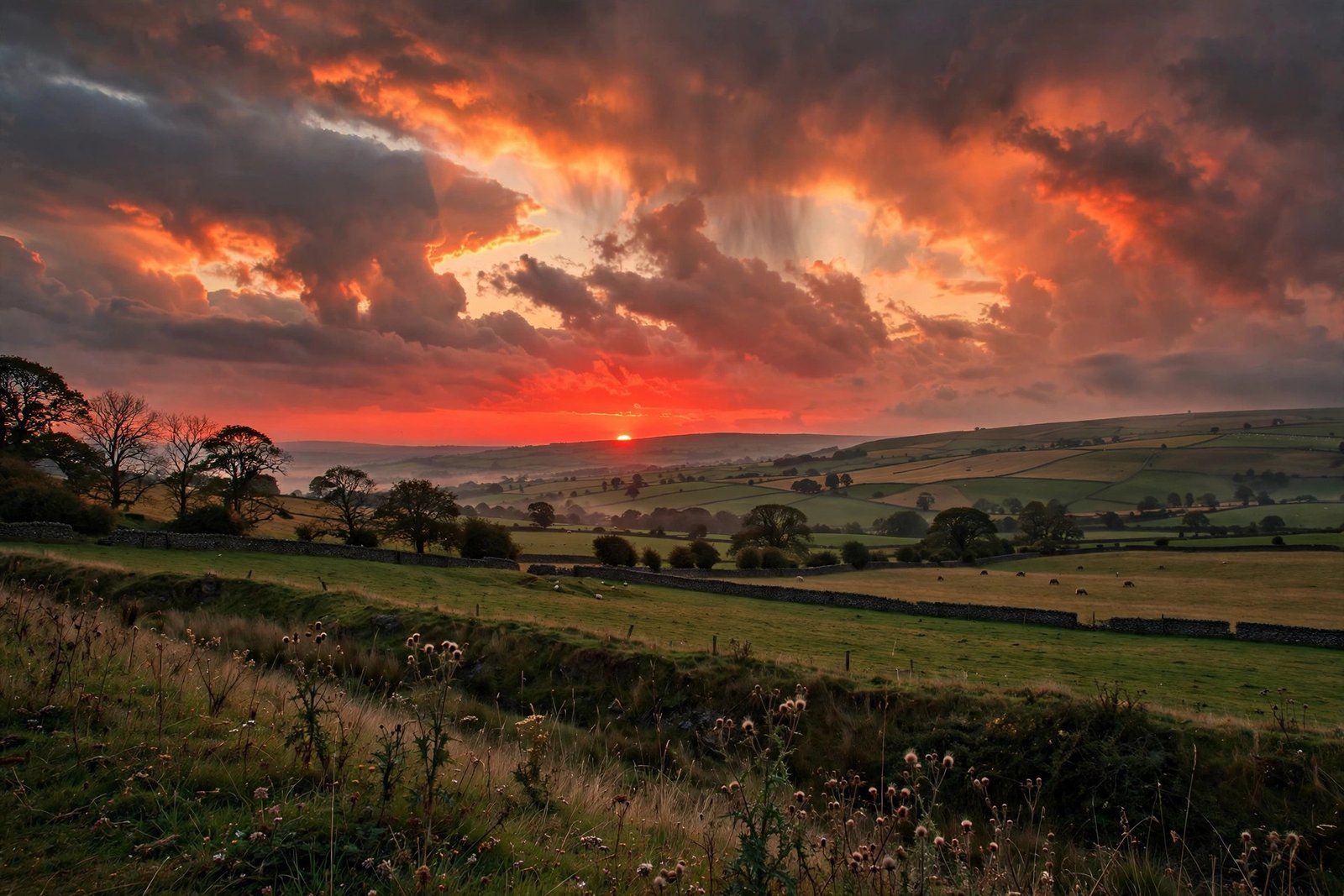
There is a moment on a clear evening when the whole sky catches fire — clouds turning pink, then orange, then a deep burning red — and everyone stops to look. Red sunsets feel almost supernatural, but the physics behind them is beautifully ordinary: the same sunlight that looks white at noon, filtered through more atmosphere. Understanding why the sky looks red at sunset takes about ten minutes, requires no background knowledge, and permanently changes how you see the evening sky.
Here is the science, explained plainly: what sunlight is made of, why the sky is blue by day, and what changes at sunset to paint it red.
Sunlight Is Not White (It Only Looks That Way)
Sunlight looks white, but it is actually a blend of every colour of the rainbow — red, orange, yellow, green, blue, indigo, violet. You can see this with a prism, a garden hose on a sunny day, or any rainbow. Each colour is light vibrating at a different wavelength: red has the longest waves, blue and violet the shortest. This single fact — that colours are wavelengths — explains the entire sky.
The Royal Observatory Greenwich has a superb plain-English explainer of how sunlight interacts with our atmosphere, and it is worth bookmarking if this topic grabs you.
Why the Sky Is Blue at Midday
When sunlight enters Earth’s atmosphere, it collides with nitrogen and oxygen molecules. Short-wavelength blue light gets scattered in all directions by these tiny particles — a process called Rayleigh scattering, after Lord Rayleigh, the British physicist who explained it in the 1870s. Longer red wavelengths mostly sail straight through.
Your eyes receive blue light arriving from every direction of the sky — hence a blue sky. (Violet scatters even more than blue, but our eyes are less sensitive to violet and the upper atmosphere absorbs much of it, so blue wins.) This is the daytime baseline. Everything at sunset is a variation on it.
Sunset: The Same Physics, More Atmosphere
At noon, sunlight travels through the thinnest possible slice of atmosphere — straight down. At sunset, the sun sits near the horizon, so its light travels a far longer, slanted path through the air to reach your eyes — up to 30 times more atmosphere than at midday. Along that long journey, almost all the blue light gets scattered away in other directions before it reaches you. What survives the trip is the long-wavelength light that barely scatters: reds, oranges and pinks.
So a red sunset is not the sun changing colour — it is the blue being filtered out along the way, leaving the reds behind. The Met Office’s guide to atmospheric optical effects illustrates this with excellent diagrams.
Why Some Sunsets Are Redder Than Others
Particles in the air amplify the effect. Clean, dry air gives delicate pink-and-gold sunsets; air full of fine particles — dust, pollution, sea salt, or volcanic ash — scatters even more blue and leaves deeper, more dramatic reds. This is why the most spectacular sunsets often follow storms (which wash out large particles but leave fine ones), and why volcanic eruptions have historically produced blood-red sunsets worldwide — the 1883 Krakatoa eruption painted skies red for years, famously captured in Munch’s The Scream.
Clouds act as the canvas: high, thin clouds catch the red light and reflect it down, while the lower sky glows. A completely clear sky gives a gentle gradient; scattered high cloud gives the full fire. The old shepherd’s saying — “red sky at night, shepherd’s delight” — has real meteorology behind it: a red sunset often means high pressure and dry, dusty air to the west, suggesting settled weather ahead. The Science Museum’s atmosphere exhibits demonstrate scattering beautifully if you want the hands-on version.
The Same Science, Everywhere Else
Once you know Rayleigh scattering, you start seeing it everywhere: the blue of a distant mountain range (air scattering between you and the peaks), the red sun through wildfire smoke (extreme particle filtering), and even why the sky on Mars is butterscotch (different atmosphere, different scattering). Astronauts photographing Earth from space see a thin blue glowing rim — our atmosphere scattering sunlight, visible from outside.
It also explains the “blue hour” photographers love: just after sunset, when the sun is below the horizon but still illuminating the upper atmosphere, the world goes briefly, magically blue. If the forecast promises clear skies, check how to dress for British weather and unpredictable spring conditions — the best sunsets deserve to be watched in comfort, not through chattering teeth.
Photographing Red Sunsets: A Beginner’s Guide
Knowing the science makes you want to capture it. You do not need fancy gear — modern phones are superb at sunsets with a few tricks. Expose for the sky: tap the brightest part of the sky on your phone screen to darken the exposure; auto-exposure will wash out the colours trying to brighten the foreground. Include foreground interest: a tree, rooftop or person silhouetted against the colour transforms a pretty sky into a photograph — pure sky gets boring fast. Shoot through the colour change: the best reds often come 10–20 minutes after sunset, when the sun illuminates high clouds from below — most people pack up too early and miss the peak.
White balance: phone cameras often “correct” sunsets toward neutral, killing the reds — try the “cloudy” white balance setting (or a sunset filter) to preserve the warmth your eyes see. Clean your lens: a fingerprint-smudged lens turns every bright sunset into a hazy mess; one wipe makes a startling difference. And put the phone down for at least a minute to just watch — the science you now know makes the unphotographed moment richer than any image.
Conclusion
The sky looks red at sunset because sunlight’s short blue wavelengths get scattered away during their long, slanted journey through the evening atmosphere, leaving the long red wavelengths to reach your eyes. Particles, clouds and clean air modulate the drama, but the physics never changes. Next time the sky catches fire, you will know exactly what you are looking at: white sunlight, filtered through thirty atmospheres’ worth of air, with the blue removed. Physics has rarely looked so beautiful.
Frequently Asked Questions
Why is the sky red at sunset but blue during the day?
At midday, sunlight takes a short path through the atmosphere and blue light scatters in all directions (blue sky). At sunset, the longer slanted path scatters away almost all blue light, leaving reds and oranges.
What is Rayleigh scattering?
The scattering of light by molecules much smaller than its wavelength, named after Lord Rayleigh. It scatters short (blue) wavelengths far more than long (red) ones — the reason for blue skies and red sunsets.
Why are some sunsets more colourful than others?
Fine particles (dust, pollution, volcanic ash) in the air enhance red sunsets, and high thin clouds act as a canvas reflecting the coloured light. Clean air gives softer pink-gold sunsets.
Is “red sky at night, shepherd’s delight” scientifically true?
Broadly, yes. A red sunset often indicates dry, dusty high-pressure air to the west, which in the UK’s weather patterns suggests settled weather approaching.
Why did the sky look red after volcanic eruptions?
Volcanic ash and sulphur particles high in the atmosphere scatter blue light extremely effectively for months or years, leaving intensely red sunrises and sunsets worldwide.


