What Causes Earthquakes? The Clearest Explanation
Why is it so hard to understand what causes earthquakes? Cracked plates, stick-slip friction and sudden release — the clearest explanation. Read the full guide.
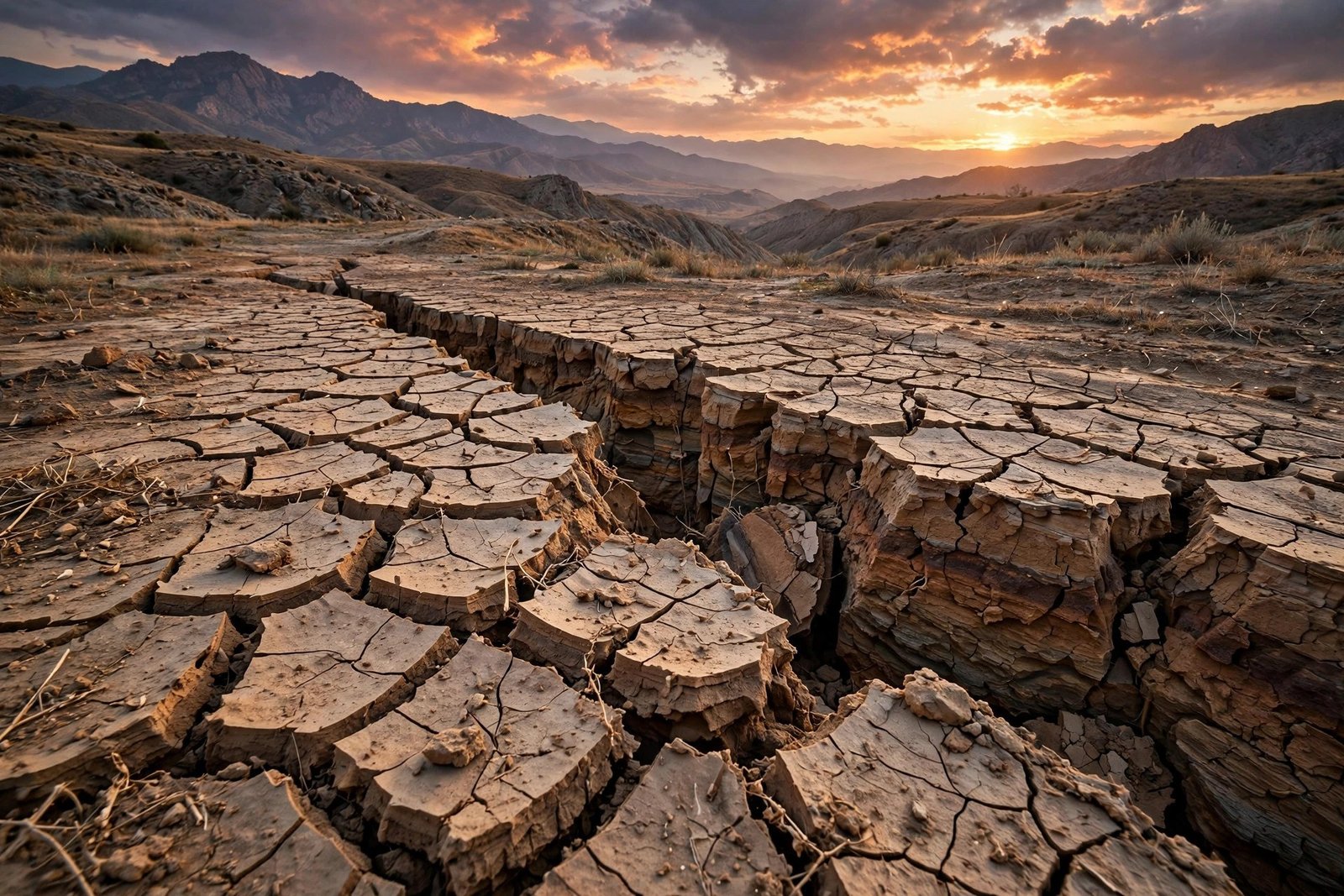
In 2011, a magnitude 9.1 earthquake off Japan moved the entire country, shifted the Earth’s axis, and unleashed a tsunami that killed over 18,000 people. The energy released equalled roughly 9,000 Hiroshima bombs — from rocks slipping past each other underground. Earthquakes are among nature’s most violent events, yet their cause remains genuinely hard to grasp: invisible forces, geological timescales, and physics that defies everyday intuition. Why is it so hard to understand what causes earthquakes? Because the answer lives kilometres beneath our feet, operates over millions of years, and involves a planet that is slowly tearing itself apart and welding itself back together. Here is the clearest explanation you will find — no geology degree required.
The core idea: Earth is cracked, and the cracks are moving
Forget the image of solid ground. The Earth’s outer shell — the lithosphere — is broken into a dozen or so massive slabs called tectonic plates, each tens to hundreds of kilometres thick, floating on the hot, slowly churning mantle beneath. These plates move — typically a few centimetres per year, about the speed your fingernails grow. That sounds trivial until you multiply by millions of years and consider the forces involved: a plate the size of a continent, grinding against its neighbour, accumulating strain like a drawn bow.
Where plates meet — the plate boundaries — is where almost all earthquakes happen. There are three types of boundary, and each makes earthquakes differently: divergent (plates pulling apart, as in Iceland’s rift valley — relatively gentle quakes), convergent (plates colliding, one diving beneath the other — the makers of the biggest quakes and tsunamis, as around the Pacific “Ring of Fire”), and transform (plates sliding sideways past each other, like California’s San Andreas Fault — the classic strike-slip quakes). The British Geological Survey maintains excellent UK-focused explainers on all three.
The stick-slip mechanism: why quakes are sudden
Here is the part that confuses everyone: if plates move centimetres per year, why do earthquakes strike in seconds? Because of friction. Plate boundaries are not smooth — they are rough, interlocked rock. The plates try to move, friction locks them, and strain accumulates silently for decades or centuries. Then, when the stress exceeds the frictional strength, the fault ruptures — years of stored motion released in seconds. This stick-slip cycle is why earthquakes are inherently sudden and why the “gradual movement” intuition fails: the motion is gradual, but its release is catastrophic.
Think of bending a stick: it flexes silently, then snaps violently. The bending is the decades of plate motion; the snap is the earthquake. Seismologists can sometimes measure the bending (with GPS monitoring of ground deformation), which is the basis of long-term forecasting — but predicting the exact snap remains beyond us, for reasons we will come to.
Magnitude, energy and why the scale confuses people
The moment magnitude scale (which replaced the Richter scale for large quakes) is logarithmic: each whole number represents about 32 times more energy. A magnitude 7 releases 32 times the energy of a magnitude 6, and roughly 1,000 times that of a magnitude 5. This is why a “small” numerical difference is a huge real difference — and why the jump from the UK’s typical magnitude 2–3 tremors to a magnitude 7 is not “a bit bigger” but a different universe of violence. Depth matters too: shallow quakes (under 70km) shake the surface far more violently than deep ones of the same magnitude.
Why the UK gets earthquakes (small ones)
Britain sits in the middle of the Eurasian plate, far from active boundaries — which is why our quakes are small and infrequent. But “far” does not mean “immune”: ancient fault lines from long-dead tectonic collisions still occasionally slip under accumulated regional stress, and the Atlantic’s slow widening pushes on us gently. The UK experiences 200–300 detectable earthquakes yearly, though only ~30 are felt — most are magnitude 2 or below. The largest known UK quake, the 1931 Dogger Bank event (magnitude 6.1), damaged buildings along the east coast. The BGS operates a UK earthquake monitoring network that locates every tremor in near-real-time — worth bookmarking if you ever feel a mysterious rumble in the night.
British earthquakes cluster in western Scotland, Wales, the Midlands and the Channel — all areas with old, weak fault zones. Fracking-related tremors (as in Lancashire in 2019) added a human-caused chapter: injecting fluids underground can lubricate small faults, triggering minor quakes — a reminder that humans can now cause earthquakes, not just suffer them.
Why prediction is so hard (the honest science)
We can say where earthquakes will happen (plate boundaries, mapped to kilometres) and roughly how big the maximum could be (from fault length and history) — but not when. The problem: faults are kilometres underground, their exact frictional state is unmeasurable, and rupture nucleation — the tiny initial slip that cascades into a quake — depends on microscopic conditions we cannot observe. It is like predicting exactly when a specific snowflake will trigger an avalanche: you can assess the slope’s danger precisely and still not know the moment. Promising research directions include AI analysis of foreshock patterns, deep borehole monitoring, and satellite deformation tracking — but any claim of reliable short-term prediction should be treated with extreme scepticism. The US Geological Survey’s earthquake science pages give the global state of the art.
What we can do is prepare: building codes in quake zones (Japan’s engineering is why its death tolls, while tragic, are far lower than the magnitudes would suggest), early-warning systems that detect the fast, weak P-waves and warn seconds before the destructive S-waves arrive, and public drills. The UK’s risk is low enough that preparation means awareness rather than engineering — but understanding the mechanism is its own kind of readiness. After all, the ground beneath Britain may feel permanent, but as our guides to dressing for British weather and unpredictable spring weather remind us, this island’s relationship with natural forces has always been humbling.
Conclusion
Earthquakes are hard to understand because their cause — tectonic plates accumulating strain over centuries and releasing it in seconds — operates on scales of depth, time and energy far outside human intuition. The mechanism itself is beautifully simple: cracked shell, moving pieces, friction, sudden slip. The difficulty is not the concept but the scales: kilometres down, centuries long, energies beyond imagining. Grasp the stick-slip idea and the logarithmic magnitude scale, and you understand more seismology than most — including why the ground, for all its apparent solidity, is always, slowly, moving.
Frequently Asked Questions
Why is it so hard to understand what causes earthquakes?
Because the mechanism operates kilometres underground over centuries — tectonic plates moving centimetres yearly, locking with friction, then releasing centuries of strain in seconds. The scales of depth, time and energy are far outside everyday intuition, though the core idea (stick-slip friction) is simple.
Can earthquakes be predicted?
Not reliably in the short term. Scientists can identify where quakes will occur and estimate maximum magnitudes, but the exact timing depends on unmeasurable underground conditions. Claims of precise prediction should be treated with scepticism.
Does the UK get earthquakes?
Yes — 200–300 per year, though only about 30 are felt. Britain sits mid-plate, so quakes are small (usually under magnitude 3), caused by ancient faults occasionally slipping. The BGS monitors them all in near-real-time.
What is the difference between magnitude and intensity?
Magnitude measures the energy released at the source (one number per quake, logarithmic — each step is ~32× more energy). Intensity measures shaking effects at a given location, which varies with distance, depth and geology.


